

Every year it arrives with the same quiet dread. Tax time rolls around, and suddenly the shoebox of receipts, the folder that was going to be sorted months ago, and the pile of invoices on the corner of the desk all demand attention at once. For a small business owner already juggling a dozen jobs, getting the paperwork in order can feel like a second full-time role.
It does not have to be that way. Good record keeping is far less about heroic end-of-year effort and far more about a few sensible habits and the right office supplies to keep everything organised as you go. This guide walks through what records an Australian small business needs to keep, how long to keep them, and how a reliable printing and filing setup turns tax time from a scramble into a simple, orderly task.
Why Record Keeping Still Matters
In an age of cloud accounting and digital everything, it is tempting to think paper records are a thing of the past. To a degree that is true, and digital record keeping is genuinely excellent. But the underlying obligation has not gone anywhere, and a surprising amount of business still runs on printed documents.
The Australian Taxation Office requires businesses to keep records that explain their transactions, and those records need to be accurate, complete, and accessible if you are ever asked to produce them. Whether they live on a screen or in a filing cabinet, you need to be able to find them, read them, and rely on them. A well-organised system, with clean printed copies of the documents that matter, protects you if a question ever arises and makes your own life dramatically easier at tax time and throughout the year.
There is also a simple practical reality. Banks, accountants, grant applications, leases, and suppliers all still ask for printed, signed, or physically filed paperwork from time to time. A business that can produce a clean, professional document at a moment's notice looks organised and trustworthy, and that impression matters.
The Records Every Small Business Should Keep
Before thinking about how to print and file, it helps to know what you are actually keeping. While every business is different, most need to hold on to a core set of records.
Income records cover the money coming in, including sales invoices, receipts you have issued, and records of any other income. Expense records cover the money going out, including supplier invoices, receipts for purchases, and bills. These two categories are the backbone of your tax return, because together they establish what you earned and what you can claim.
Beyond those, most businesses need to keep records relating to their employees, such as wages, superannuation, and pay records, along with any documents tied to the Goods and Services Tax if you are registered, including your business activity statements. Bank statements, loan documents, contracts, leases, and asset purchase records round out the picture. If a document supports a number on your tax return or explains a business decision, it is worth keeping.
The key principle is that your records should tell a clear and complete story of your business finances. If someone unfamiliar with your business could pick up your files and understand what happened and why, you are in good shape.
How Long You Need to Keep Them
One of the most common questions is how long all this paperwork needs to hang around. As a general rule in Australia, businesses are expected to keep most records for at least five years from the date the record was prepared or the transaction was completed, whichever is later. Some records, particularly those relating to assets or capital gains, may need to be kept for longer, because the relevant period can start from when you eventually sell the asset rather than when you bought it.
Because the timeframes can vary and the rules do change, it is always worth confirming the current requirements for your specific situation with your accountant or the ATO directly. What this means in practice, though, is clear enough. You are going to be storing several years of records at any given time, so a system that keeps them organised, legible, and easy to retrieve is not a luxury. It is essential.
This is exactly why a reliable printing and filing setup pays for itself. Records that fade, smudge, or go missing are worse than useless, and reprinting or reconstructing them years later is a nightmare. Clean, durable copies filed sensibly the first time save enormous stress down the track.
Building a Simple, Reliable Printing Setup
You do not need an elaborate system to keep good records. You need a dependable printer, the right consumables, and a handful of supplies that keep everything tidy.
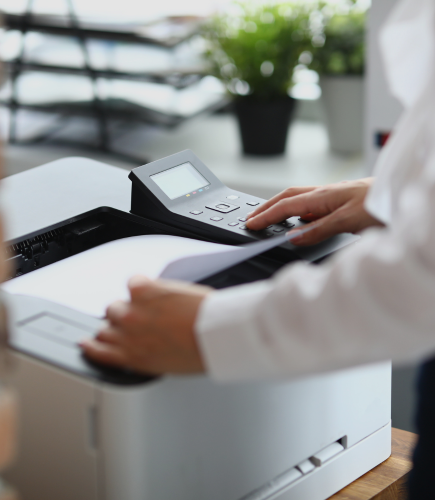
Start with the printer itself. For a business that prints a lot of text-based documents such as invoices, statements, and reports, a laser printer is usually the most sensible choice, because it produces sharp, smudge-resistant text quickly and its running cost per page is low. If your work involves more colour, photos, or marketing material, an inkjet may suit you better. Matching the printer to your actual printing habits is the single biggest factor in keeping both costs and frustration down.
Just as important is making sure you never run dry at the wrong moment. There is nothing worse than an empty cartridge the night before a deadline. Keeping a spare set of ink or toner on hand means a low-cartridge warning is a minor note rather than an emergency. Choosing quality cartridges, whether original or good compatible options, also ensures your printed records stay crisp and legible for the years you need to keep them, rather than fading in the filing cabinet.
Then there is the paper. Standard copy paper is fine for everyday records, but it is worth keeping a small stock of heavier paper for documents that need to look and feel more professional, such as contracts, quotes, and anything you send to clients. A document printed on decent paper simply carries more authority.
The Supplies That Keep It All Organised
A printer is only half the story. What turns a pile of printed pages into a system you can actually use at tax time is the humble world of organisational supplies.
Labels are one of the most underrated tools a small business has. A label printer or a sheet of printable labels lets you clearly mark folders, files, and archive boxes, so that finding last quarter's invoices takes seconds rather than an afternoon. Clear, consistent labelling is the difference between a filing system and a filing pile.
Beyond labels, the basics do a lot of quiet work. Manila folders, ring binders, dividers, and archive boxes give every category of record a proper home. Highlighters and sticky flags help you mark the documents that need action or signature. A stapler and a hole punch keep related pages together so nothing wanders off. None of this is glamorous, but together these small items are what make a record-keeping system hold together through a busy year.
For sensitive documents that have passed their retention period, a shredder is the responsible way to dispose of them. Financial records contain exactly the sort of information identity thieves look for, so shredding rather than binning old paperwork is a simple, sensible safeguard for both you and your clients.
Turning Tax Time Into a Non-Event
The real secret to painless tax time is that the work is spread across the year rather than crammed into a panicked week. A few small habits make all the difference.
Set aside a regular time, even just fifteen minutes a week, to print, file, and label the documents that have come in. Keep your spare cartridges and paper stocked so printing is never a barrier. Create a clear folder for each category of record and each financial year, and label everything as you go. When you deal with a receipt or invoice once, properly, at the moment it arrives, it never becomes part of a daunting pile later.
Do this consistently and the end of the financial year stops being a mountain to climb. Instead of hunting for lost documents and reprinting faded receipts, you simply hand your accountant a complete, well-organised set of records, and get back to running your business. The small ongoing effort, supported by a reliable printer and the right supplies, pays for itself many times over in saved time and reduced stress.
Cartridge World has been helping Australian small businesses stay organised and productive since 1992, with a full range of printers, ink and toner, paper, labels, shredders, and everyday office supplies to keep your record keeping running smoothly all year round. If you are setting up a new system or refreshing an old one, the team can help you find exactly what you need to make the next tax time your easiest yet.