


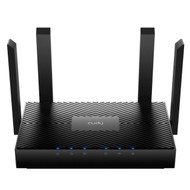
The continuous transformation of local area network technology requires hardware capable of addressing increasing client numbers and higher bandwidth demands. As residential and light commercial environments integrate a larger number of high data volume devices, historical wireless architectures often experience systemic latency and throughput degradation. This technical assessment examines the capabilities, physical engineering, and network efficiency of the
Silicon Foundations and Interface Design
The operational reliability of a routing gateway depends significantly on its core silicon processing capabilities. Unlike older consumer models that frequently suffered from buffer overflows during heavy traffic, this unit incorporates a 1.3 Gigahertz Dual-Core Cortex-A53 central processing unit. This structural framework allows the router to manage concurrent encryption loops, package inspections, and address translations without causing thermal instability or memory saturation.
Wired Interconnect Infrastructure
While wireless data distribution remains the focus for mobile devices, stationary hardware like primary network switches, local storage appliances, and enterprise computers require physical copper connectivity to guarantee minimal latency. The backplane configuration of this router features four high speed Ethernet interfaces:
-
Dedicated WAN Port: Operating at 10/100/1000 Megabits per second, this interface links directly to incoming broadband termination endpoints, including fiber to the premises or hybrid fiber coaxial network connections.
-
Three Local LAN Ports: These ports also support full Gigabit performance, ensuring that internal network file synchronization remains unbottlenecked by local hardware interfaces.
External Design and Airflow Management
The chassis features a slim, modern appearance that fits cleanly into residential or office spaces. Beyond aesthetics, the physical layout prioritises functional thermal dynamics. Strategic ventilation grills around the lower shell prevent internal components from overheating during periods of sustained, high volume data transfers.
Wireless Architecture and the WiFi 6 Protocol
The main advancement of this device is the shift to the AX3000 standard, a specification that relies heavily on the architectural improvements introduced by the WiFi 6 protocol. This framework introduces specific mechanisms designed to improve spectral efficiency and increase capacity across high density local cells.
Bandwidth Distribution Across Dual Frequencies
The AX3000 rating represents a theoretical combined maximum throughput of up to 3000 Megabits per second. This capacity is split strategically across two active transmission bands:
-
The 5 Gigahertz Spectrum: This band utilizes wider channel allocations to deliver up to 2402 Megabits per second. It handles high priority tasks like simultaneous high definition media streaming, voice over internet protocol communications, and massive asset transfers.
-
The 2.4 Gigahertz Spectrum: This band provides up to 574 Megabits per second. It acts as a reliable long range baseline for low consumption devices, including internet of things sensors, automated printing systems, and simple terminal browsers.
Orthogonal Frequency Division Multiple Access (OFDMA)
In traditional older wireless systems, a router could only transmit data to a single client per channel at any given millisecond. This system resulted in packet queues and increased latency when numerous devices requested data concurrently.
This model implements OFDMA technology, which breaks down individual wireless channels into smaller sub channels known as resource units. This lets the router bundle data packets intended for different clients and transmit them in a single broadcast cycle. This functionality significantly minimizes idle radio time and maintains consistent network performance even when managing numerous background data streams.
Advanced Multi User Spatial Streaming
The router features four high gain external antennas designed to create a 4-stream, Multi-User Multiple Input Multiple Output configuration. Combined with beamforming technology, the device actively calculates the physical location of connected client equipment and concentrates radio energy toward those specific coordinates, rather than broadcasting a uniform signal across the room. This targeted approach improves wall penetration and maintains connection stability at longer distances.
Scalability and Mesh Networking Architecture
A persistent issue with single unit wireless deployments is signal attenuation over large physical footprints. Structural elements like solid concrete walls, metal support beams, and thermal glass can severely degrade high frequency signals, creating problematic dead zones.
Cudy Mesh Topology
To resolve coverage limitations without requiring complex secondary routing configurations, the device includes native Cudy Mesh capabilities. This protocol allows users to link multiple compatible access points into a cohesive, cooperative network system. In this arrangement, secondary units act as smart signal nodes rather than simple independent repeaters.
Intelligent Client Handshakes
Traditional network extenders often force client devices to stick to a distant, weak signal until the connection drops completely before reconnecting to a closer source. The integrated mesh logic uses standardized roaming protocols to manage client transitions between access points automatically. As a user moves through a 130 square meter space, the network dynamically shifts the client connection to the optimal node without causing active session drops, pocket loss, or video conferencing interruptions.
Security Frameworks and Virtual Private Networking
Modern network security requires proactive measures at the local edge router to protect local hardware from external vulnerabilities. This device features an updated security layer configured to meet current protection standards.
Modern Wireless Encryption
The system supports the modern Wi-Fi Protected Access 3 (WPA3) protocol, which delivers significant security enhancements over legacy WPA2 systems. WPA3 utilizes a more secure key exchange process designed to defend against offline dictionary attacks, offering an important layer of protection for personal and business data even when users choose weak network passwords.
Integrated Virtual Private Network (VPN) Operations
For remote employees and privacy conscious administrators, the device includes native support for both VPN Server and Client protocols. It manages multiple secure encryption systems, including OpenVPN, WireGuard, PPTP, and L2TP:
-
VPN Server Functionality: This feature allows remote operators to establish an encrypted tunnel back into their home or office network from an external location, providing secure access to local files and intranet services.
-
VPN Client Functionality: This capability allows the router to encrypt all outgoing internet traffic at the gateway level. Any connected device, from smart televisions to security systems, is automatically routed through the secure VPN tunnel without requiring individual software configurations on each endpoint.
Configuration Methods and System Oversight
Deploying modern networking hardware requires accessible software management interfaces that cater to both everyday users and experienced network administrators.
The Cudy Application Ecosystem
For direct, straightforward deployments, the proprietary Cudy App provides a clear setup path. Users connect the router to their internet source, scan for the device via their smartphone, and follow a brief step by step process to configure initial parameters, set network passwords, and establish basic operational bands. The application also supports cloud control, allowing off site monitoring and remote troubleshooting of the network from any location with an active internet connection.
Advanced Web Browser Interface
For advanced users who require precise, granular control over their network architecture, the local web interface provides full access to the router system settings. This portal includes options for configuring demilitarised zones, managing static address assignments, custom firewall policies, and setting up parental control profiles to restrict specific online content or block internet access during selected hours.
Technical Merits and System Limitations
An objective evaluation of this networking hardware requires a clear assessment of its strong points alongside its practical constraints.
Advantages
-
Processing Efficiency: The 1.3 Gigahertz Dual-Core processor easily handles demanding tasks like heavy data processing and real time VPN encryption without causing stability issues.
-
Modern Spectrum Management: The inclusion of WiFi 6 features like OFDMA and MU-MIMO allows the system to manage up to 200 connected devices smoothly.
-
Flexible VPN Tools: Native support for modern protocols like WireGuard allows for efficient encryption at the gateway level without major throughput loss.
-
Affordable Entry Point: At a highly competitive price of 99.00 dollars, this device offers advanced WiFi 6 features at a accessible cost for budget conscious installations.
Limitations
-
Physical Port Limitations: The presence of only three local LAN ports may prove restrictive for environments with large arrays of wired workstations, which could necessitate the addition of a secondary network switch.
-
Footprint Restrictions: A single unit covers an estimated 130 square meters; larger spaces or complex multi level buildings will require purchasing additional nodes to create a complete mesh network.
Final Assessment and Practical Application
The Cudy WR3000 AX3000 Gigabit WiFi 6 Mesh Router is a well balanced, reliable choice for modernizing standard home or small office networks. By avoiding unnecessary aesthetic frills and focusing on core performance features like a capable dual core processor, robust VPN tools, and efficient WiFi 6 resource allocation, the router handles high density device connections effortlessly. While massive enterprise layouts or complex multi floor buildings will require adding extra mesh units, a single node offers an efficient, stable, and highly cost effective foundation for anyone looking to build a reliable local area network.